
The new process system is only in the early access version of Human Generator. It replaces the process tab of earlier versions, which is deprecated. Details can still change. If something doesn't work, or the result is not what you expected, let us know, on the Discord or by email.
Skeleton
The rig of a Human Generator human is made for animating in Blender: it has control bones, constraints, drivers and a face rig. A game engine wants the opposite, a plain hierarchy of deforming bones with names it recognizes. The Skeleton section makes that skeleton from the rig:
- Control bones, constraints and drivers are removed; what they did to the pose is baked in.
- The weights of bones you don't keep (see below) are merged into their parents, so nothing deforms differently.
- A root bone is added at the origin, which carries the movement of the character.
- The bones are renamed for the engine, the number of bones per vertex is limited, and the rest pose becomes the T-pose when the engine expects it.
- Shape keys driven by bones, like the face rig and the correctives, stay as blend shapes, see Shape Keys.
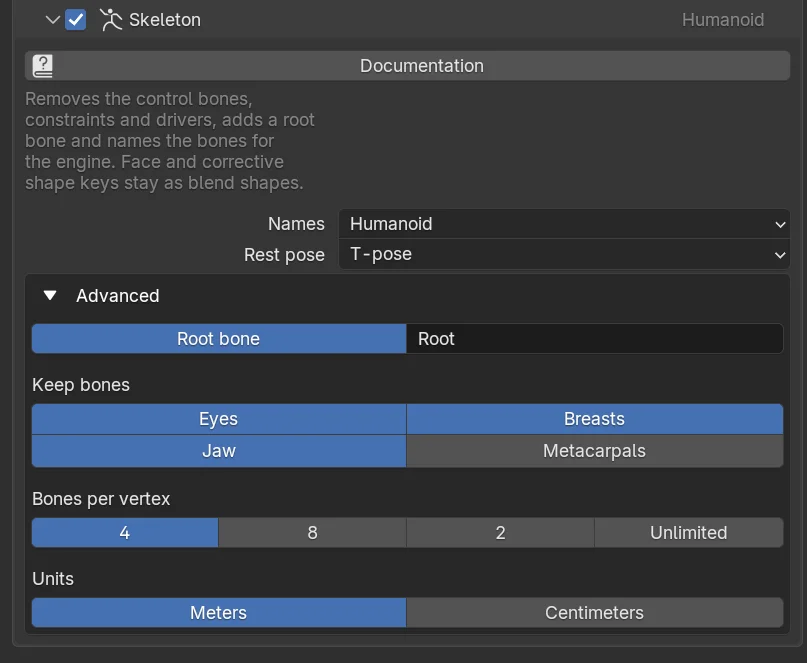
Names
Which naming the bones get. The recipes pick this for you; the names matter because engines map a skeleton to their own by name.
| Names | For |
|---|---|
| Humanoid | Unity's Humanoid rig, Godot's humanoid skeleton profile and VRM. The engines recognize the bones automatically. |
| Unreal | The bone names of the Unreal Engine Mannequin, for the IK Retargeter and animations made for the Mannequin. |
| Mixamo | The Mixamo skeleton, so animations from the Mixamo library play without retargeting. |
| Human Generator | The original Human Generator names, for any program where you retarget by hand. |
| Custom file | Your own names, from a JSON file. See Custom bone names. |
Rest pose
The pose the skeleton has when no animation plays.
- T-pose: arms straight out. What Unity, Godot, VRM, Mixamo and most retargeting tools expect. The current pose of the human is discarded.
- A-pose: arms down at an angle, the rest pose of Human Generator itself and of the Unreal Mannequin.
Pick what the engine or your animations expect; a mismatch shows as arms that are raised or lowered in every animation. The shoulder corrective shape keys only make sense in the A-pose, so they are removed with the T-pose.
Advanced
Root bone
Adds a bone at the origin, above the hips, named Root (Unity, Godot) or root (Unreal) by the recipe. Engines use it for root motion, and most retargeting tools expect one. Mixamo skeletons have none, so that recipe turns it off.
Keep bones
Bones that are not needed for every character. A bone you don't keep is removed and its weights go to its parent, so the mesh still deforms.
- Eyes: the two eye bones. Off, the eyes are fixed in the head and follow it.
- Jaw: the jaw bones that open the mouth and move the lower teeth. Keep them for lip sync by bones; the face rig blend shapes open the mouth too.
- Breasts: the breast bones, for physics or secondary animation.
- Metacarpals: the palm bones between the hand and the fingers. Most engine skeletons don't have them, so they are off by default; their weights go to the hand.
Bones per vertex
How many bones may deform one vertex. 4 is the default of Unity and Unreal and works everywhere. 8 deforms smoother at the shoulders and hips but needs the higher limit enabled in the engine. 2 for mobile and VR, where engines often clamp to two bones. Unlimited keeps every weight and lets the engine decide. With several LOD levels each level has its own limit.
Units
FBX only. Meters are what Blender, Unity, Godot and Mixamo use. Centimeters are Unreal's units; the recipe sets them so the character imports at scale 1 instead of 0.01.
Rigify humans
A human with a Rigify rig has no Human Generator rig to make the skeleton from, so the section is skipped and the Rigify rig is exported as it is. Everything else in the process works normally.
Custom bone names
For a program that is not covered, set Names to Custom file and point File to a JSON file. It maps the Human Generator bone names to the names you want, and tells how the left and right sides are written:
{
    "sides": {
        "L": {"side": "l", "Side": "Left", "suffix": "_l"},
        "R": {"side": "r", "Side": "Right", "suffix": "_r"}
    },
    "names": {
        "spine": "pelvis",
        "spine.001": "spine_01",
        "neck": "neck_01",
        "head": "head",
        "upper_arm": "upperarm_{side}",
        "forearm": "lowerarm_{side}",
        "hand": "hand_{side}"
    }
}
The keys of names are the Human Generator bone names without their .L/.R side suffix. A name can hold {side}, {Side} or {suffix}, which are filled in from sides for the left and right bone: upperarm_{side} gives upperarm_l and upperarm_r, {Side}UpperArm gives LeftUpperArm. Only names is required; bones you leave out keep their name. The built-in presets are in human/process/game_rig_presets.json inside the add-on and list every bone, copy one as a starting point.
In Blender the face rig and the corrective shape keys are driven by bones. Exported files don't carry drivers, so in the other program those blend shapes exist but don't move with the bones until you connect them there, or you drive them from your own animation. See Shape Keys.
Python API - Skeleton
settings.skeleton.names = "unreal"      # "humanoid", "unreal", "mixamo", "humgen", "custom"
settings.skeleton.rest_pose = "a_pose"  # or "t_pose"
settings.skeleton.keep_metacarpals = True
settings.lods[0].bones_per_vertex = 8
To convert a human in place (on a human.duplicate(), it can't be undone):
human.process.convert_to_game_rig(preset="humanoid")  # applies the T-pose first when the preset wants it
human.process.convert_to_game_rig(settings=settings.skeleton, max_influences=4)
See SkeletonSettings, ProcessSettings › convert_to_game_rig and ProcessSettings › set_t_pose_as_rest.